


Continuation from Positions and Practice- A review of progress and research methods.
I have been exploring changes within masculinity, which has been inspired by Grayson Perry’s book The Decent of Man that looks in part, at the harm rigid masculine roles can do. The starting point for my research was to focus on my first male role model (my father) to perhaps understand how aspects of my own masculinity have been shaped by his influences. I may revisit this during this module as I believe there is still more ground to cover here.
I’ve been producing pinhole images with long exposures, which require a great deal of trial and error. Justin Quinnell's pinhole photographs and in particular his solargraphs have been a useful point of reference for me. The process of capturing images in this way often leads to unexpected results, so from that perspective, the research itself and the outcome are difficult to separate. Susan Derges works in a similar way with her camera-less images produced in rivers and doesn't feel that she really conducts research as mentioned in the case study in one of this week's resources ‘Shirley Read: Finding and Knowing - Thinking about Ideas’ p114. I have included a composition below formed from a pinhole image I captured which was intended as a living monument to my Father. My intention was to capture an 8 day exposure of the Grandfather clock which would not require any development , but this produced rather poor results. The image you see below was a two hour exposure developed with a weak solution.
Another body of work I’ve been researching is Sophie Calle’s ‘Take Care of Yourself’ 2007 that used a variety of personal handwritten notes, emails etc that was a response to a relationship ending. This was a strong influence in my piece ‘Comes with Instructions’ (2nd image attached below) as it encouraged me to gather significant objects, whether they be personal possessions or even a handwritten note in the case of this image. I suppose I see this process of gathering relevant ‘things’ as a form of research that may inform or even feature in my work in some way.


I started with the idea of exploring places that were no longer accessible to my father due to his disability, this include muddy tracks, forests and moorland. I wanted to place him in these now nearly inaccessible places. In the previous module Positions and Practice, I was exploring the concept of creating living monuments to my father through the pinhole photographs of his grandfather clock. In this module, I wanted to take this a step further and memorialise the places that were effective 'out of bounds' but were places that in the past were special to him. For example, the images of tree bark and fungus in the new forest were used as when able-bodied he would spend time exploring woodland foraging for different fungi. The Tors on Dartmoor were special places as together we would ski here in the winter months and fly fish for wild trout in the rivers and streams.
I was looking for rocks that resembled faces as I wanted to try blending the portraits of my father into the shape of the stone. As I was exploring the concept of male role models I started to think about the Mount Rushmore an the founding fathers so this was something of an influence in creating the stone/face composite.

In response to Caroline Perez’s book invisible women I have been exploring ways in which our world is structured in reference to men and their needs. For example she argues that the way in language is used for the male to always be the default. The way in which medical data recorded is from men and fails to diagnose women correctly, she also discussed crash test dummies being configured to match men’s body type and heating in offices to name but a few. With this in mind and through a lens I looked to see if there was evidence of this bias in the way the world is constructed. I certainly found that the male as default was often a design decision, but interestingly found more telling scenes that spoke volumes about masculinity.
I also explored the concept of the’ man cave’, with an element of humour I turned the camera on myself. Man caves, feature ‘manly things’, cigars, beer fridges, arcade machines, punch bags, dart boards. Perhaps the 20thCentury man needs a domain, a sence of power over a place where he can do manly things like watch a football match or not talk about his feelings with friendly fellow man cave dwellers paying a visit. I juxtaposed this with a self portrait of me with a definitive sign of a midlife crisis, A leica camera. As Ken Rockwell alluded to in his hilarious article about ‘The Leica Man’ he is not interested in 2ndbest. https://kenrockwell.com/leica/images/m7/hermes/L1040373-1200.jpg
I should like to explore the concept of the man cave further in future modules


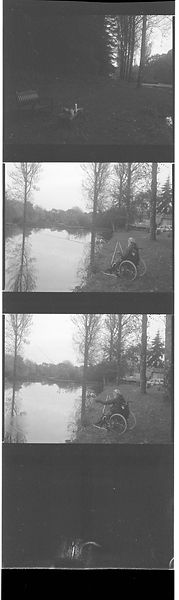
London Shoot Contact sheets leading to Way Out and Welcome to the Friars Club


Reflection on Acorn Boxing Show 30th November 2019
I was fortunate enough to find a boxing show to photograph through a local promoter/trainer who I had happened to work with many years ago. His name is Gareth Hogg and was a very success professional boxer. He allowed me access to the backstage areas and at ringside during the contests, there was another photographer, who clearly marked his territory. However, this did not impact the opportunities that I had, and it was an extraordinary event to photograph. Having connections to many of the people there really helped to remove the barrier of being an outsider and though some people I hadn’t seen in years, they were very welcoming.
It was a challenging environment to shoot in. I have shot many boxing shows before but there were only 2 lights in the ring and no other light sources which made it very difficult to capture useable images. Flash is really uncommonly used as it is too intrusive.
As a result of this I had to shoot at very high ISO’s up to 12800 at some points. Fortunately, my 1stbody was Nikon D850 which performs well in these low light conditions. The images captured would be likely a little noisy, but my intention was the display the images in Black and white which worked well with the grittiness. The rationale for using black and white was that I had always felt that the aesthetic captured in Martin Scorsese’s Raging Bull (1980) was a very accurate approximation of being in a boxing ring, From memories of my own fights, it does almost feel as though you are seeing things in black and white, because of the light in and the situation.
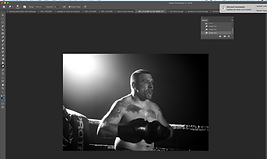
I had two digital bodies both with battery grips as the sheer volume you have to shoot takes its toll on the equipment. Capturing the impact of a punch is a surprising rare event when photographing boxing as can be seen by the few number of shots that capture this in news stories. It takes persistence and a little luck. I shot nearly 5000 images within 5hours, this makes contact sheets rather useless, hence I have only included a brief example of this. To edit form this massive volume of shots, it is easier to scroll through lightroom with roughly 8 shots on the screen at a time. I’m know what I’m looking for so this speeds up the process, but still a very time-consuming editing process. Most images had some minor tweaks such as levels, nose reduction and some sharpening before being exported to Photoshop for final cropping and fine-tuning levels.
It’s one of the most tiring types of photography as you are constantly have to change settings whilst maintain a high state of awareness about what is unfolding in front of you, ISO is frequently needs changing, as do focusing modes from single to continuous areas focus and shutter speeds often needs changing too. The only setting that is likely to remain the same is the aperture as you need as wide as possible for the available light unless using long exposures with movement. I had a range of lenses, but my best option was 24mm-120m F4. Primes are fairly useless for action as you can’t move in any closer when the fighters move around. Ideally, I would use a 2.8 24-70mm, so I may have to invest in one for future shows, the F4 was on the edge of being a workable lens for this.
In addition to shooting digital I also took my Leica M6 rangefinder to capture some more discrete images. Having 3 camera bodies at once may have left me looking rather like Dennis Hopper in Apocalypse Now but it was a necessity to cover both the sports and documentary aspects. I had a 50mm Prime F2 which was useful for documentary-based images in these appalling lighting conditions. I shot on Ilford 3200 which I had to push a little in development to ensure I got some useable frames.
The printing of the images in the dark room resulted in around 4 images, with the Ambulance and Long is the Way images being the most successful. The negatives were fairly ‘punchy’ or ‘contrasty’ which was a little surprising as when I had shoot some 3200 many years ago the negatives were very thin and required the use of 4 or 5 filter when enlarging.
The printing process went relatively well with some dodging and burning used to level out the exposures. From here I scanned the darkroom prints at a high resolution and made a few final tweaks to the levels in Photoshop. I felt that ‘Long is the Way’ the shot of the ring entrance was the strongest image shot on the Leica. It made me think of John Milton’s Paradise Lost(1667), and the quote ‘Long is the way and hard, that out of hell leads up to light’ The fighters puts themselves through the hard training, the psychological impact and the fight itself so in many ways they view this a form of hells through which they must navigate through to victory. The suffering they endure often only serves to spur them on. There’s some element of masochism in all boxers, of that I am sure.


Over 5000 images were captured and edited through Lightroom and PS

Vitruvian Man - Leonardo 1490
The shot of the 3 men in the crowd with the many arms and mobile phones really made me think of this and the Vishnu, so the The Viruvian Men it became.



Janus developments


